
Declan Hurl—an appreciation
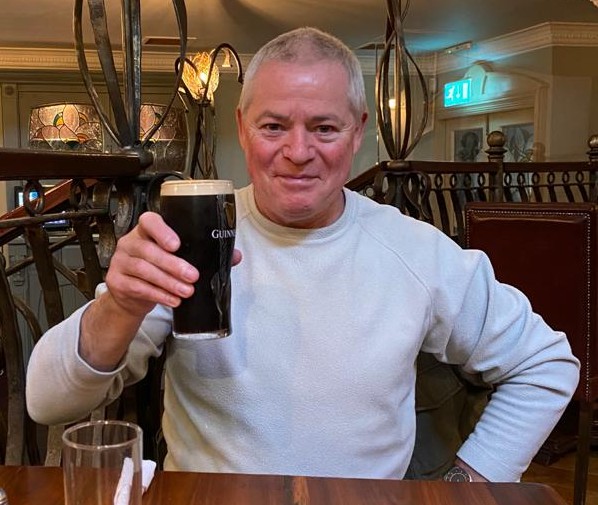
Declan Hurl began his academic career not as an archaeologist but in the Department of Anthropology at Queen’s University Belfast, where he initially graduated with a BA in Social Anthropology in 1978. But while studying anthropology, Declan had already taken part in some of his first archaeological excavations, spending summers digging with Dr Chris Lynn, an Inspector with the Archaeological Survey (forerunner of the Environment and Heritage Service (EHS), now the Historic Environment Division, Department for Communities). In 1975 he worked at the Bronze Age ritual site of the King’s Stables, part of the Navan complex in County Armagh, and in 1976 in Armagh city, to which he returned as a site director in his own right years later.
Declan continued digging with Chris Lynn through the late 1970s and 1980s, in particular being a key member of the team that excavated the raised rath at Deer Park Farms, Co. Antrim. In painstaking detail, Declan worked out the complex weave of the wicker walls of the superbly preserved early medieval houses, deconstructing the details of the positions of the rows of stakes and how the rods were woven between them to build the extremely strong and durable double-walled structures. In addition to excavating, Declan was also the site tour guide and inspired visitors to Deer Park Farms, both young and old, with his enthusiasm for the past. He never lost his enthusiasm for archaeology and for passing on information.
Declan went to Oxford in 1990 to study for a Postgraduate Certificate in Field Archaeology, returning to Belfast in 1991. In 1992 he joined the EHS as an archaeological inspector, and over the next decade and a half he directed an important series of excavations of prehistoric and medieval sites.
Among the important prehistoric excavations that he conducted were the discovery and excavation of Early Bronze Age burials at Tonyglaskan, Co. Tyrone, and Lislaird, Co. Fermanagh; the excavation of a wedge tomb at Ballybriest, Co. Derry; excavations of an enigmatic peatland site with evidence of grain-processing at Killymoon, Co. Tyrone, which resulted in the discovery of an amazing Late Bronze Age gold dress-fastener and sleeve-fastener; and the excavation of Iron Age palisades close to the western entrance into the Dorsey, Co. Armagh.
Amongst his important medieval excavations were Solar, Co. Antrim, where he uncovered an unknown early medieval cemetery; excavations beneath the modern St Patrick’s parish church at the Patrician site of Armoy, Co. Antrim, revealing details of an earlier medieval church; uncovering early medieval ditches and gullies at Abbey Street on Cathedral Hill, Armagh; and excavating a rural medieval house site at Portmuck, Co. Antrim. The majority of these sites have been fully published in the Ulster Journal of Archaeology.
In addition, Declan coordinated the work of the EHS’s Archaeological Excavation Unit (AEU) from 1998 to 2002 and was the EHS Liaison Officer with the Centre for Archaeological Fieldwork (CAF) at Queen’s University Belfast from 2002 to 2007.
Declan was deeply involved in the archaeological profession in Ireland, and he was a regular attendee at conferences across the island. He was a founding member of the Irish Post-Medieval Archaeology Group (IPMAG) in 1999 and secretary of the Irish Association of Professional Archaeologists (IAPA, now the Institute of Archaeologists of Ireland) in the mid-1990s. He was a great supporter of Archaeology Ireland.
In 2008 Declan left government archaeology, working in commercial archaeology in England and Scotland, as well as in Northern Ireland for a number of engineering companies, until his retirement in 2022.
But for all those who knew Declan, while archaeology was fundamental to his being, it was only one part of his huge personality. He was generous to a fault, and he always had time for people. He loved his family and his friends. He was broadly intellectual, a great conversationalist, raconteur and all-round excellent company. He was a commercially qualified diver and was fascinated by Egyptology. Declan loved science fiction, from Olaf Stapledon to Philip K. Dick, and rock music, in particular ’70s rock—he was a huge fan of Led Zeppelin, Free, Family and Pink Floyd. He was a man of enjoyable contradictions—intense but chilled, a rationalist who loved the mystical, a professional who paid great attention to detail, and very much a child of the ’60s. Never one to miss a party, he did a particularly good impersonation of a Catholic priest.
At social events and occasions Declan, without ever seeking it, was almost always the centre of attention. His combination of wit, intelligence and, quite simply, a larger-than-life personality ensured that people would want to talk with and listen to him. Recently, at a small get-together in Belfast which Declan was not able to attend, his absence was noticed and people affectionately began to tell ‘Declan stories’, of which there are many—‘Do you remember the time Declan …?’. After about 45 minutes, someone pointed out that Declan was even more at the centre of the conversation in absentia than if he had actually been present. His urgency, his passion and his vitality, which we all experienced, will ensure that he will continue to be talked about in absentia for many years. His professional and personal legacy will live on. And we will miss him.
Dr Cormac McSparron, Jackie McDowell, Norman Crothers and Ruairí Ó Baoill